Theo and I tested the TR-1 motor on Saturday and
unfortunately suffered a cato. It was an impressive sounding motor for
that first few milliseconds though. Apparently I should have rethought my
decision to use Dextrose in place of Sorbitol. On paper the change seemed
fine but I had limited experience with Dextrose and never in something of this
size. The actual casting of the grain segments went fine but I
experienced some slumping in two of segments that I cast. At the time I decided
that the slumping was due to having removed the segments in question too soon
from the mould. I believe that segment slump either contributed to or was
the direct cause of the cato. Fortunately I had cast an extra segment and
at the end of the day, long after the firing, that segment which had been stored
in the same conditions as some similarly sized Sorbitol segments that Rick had
cast had slumped. The sorbitol segments remained fine. The dextrose segment had slumped so severely
that the core was essentially gone. I
know of many folks that have use dextrose based propellants with no reports of
slumping so I’m unclear of the reason, maybe the size of the segments? For now I will switch back to Sorbitol in the
TR-1 motor and save the dextrose for some much smaller scale motor testing. We had a good time regardless. The guys at FAR were very helpful, and the
site had grown quite a bit since our last visit there some three years or so
ago. Rick Maschek also provided lots of assitance and camera work. Rick also had a nice firing of a KNSB motor with a Double-D grain configuration. The third photo is of Rick's firing. The last photo is af an AP motor firing that anomther FAR member (Erik, I think) conducted.
Showing posts with label TR-1 Rocket. Show all posts
Monday, September 22, 2014
Monday, September 15, 2014
TR-1 Test Fit
Tested the fit of the nozzle and bulkhead with o-rings installed. Everything fit together nicely and no adjustments were made.
Wednesday, September 10, 2014
Dextrose
The Dextrose from Lucky Vitamin has arrived. I want to do a little testing with it since I don't have a lot of experience with Dextrose. At least not nearly as much as with Sorbitol or Sucrose.
Tuesday, September 9, 2014
TR-1 Motor Update
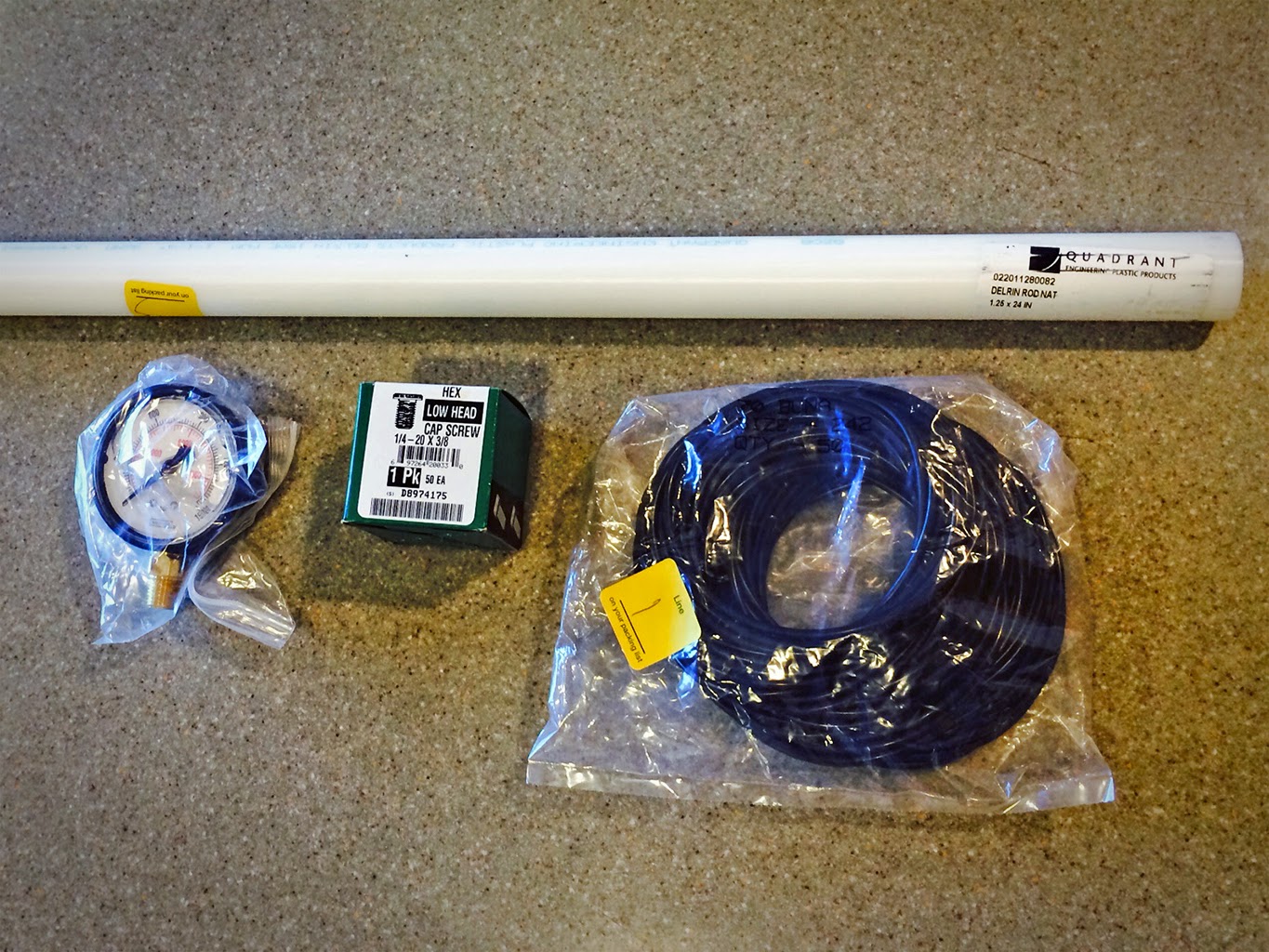
McMaster-Carr order arrived yesterday and included the o-rings, Delrin rod, screws, and pressure gauge. I didn't get a chance to assemble the motor for a final test fit, but now that I have the o-rings that's next on the list of things to do. The Delrin rod for casting the core in the propellant segments was a perfect fit in the casting base, so I'll just need to cut to length. Delrin would be an ideal choice for the casting bases too, but the stock I need would be around $60 for two bases, so I'll stick with wood for now.
Monday, September 8, 2014
TR-1 Motor Update
This past weekend I finished a few more tasks, although it's starting to look like I may not be quite ready to test fire the motor by the 20th of this month like I was hoping to do. I was hoping to get o-rings by Saturday so I could do a final test fit of the nozzle and bulkhead but I didn't get them on Saturday like I had hoped, but I can do that this week as it shouldn't take long. I did some minor machining on the nozzle to get the two pieces to mate together perfectly. I also took the time to go back and adjust the inlet a bit by machining the inlet at decreasing inlet angles (30, 15, and 7.5 degrees) and then grinding and polishing smooth so the inlet is MUCH smoother and gradual transition to the throat. No change to the throat diameter was made.
I also made two casting bases out of scrap redwood that I had lying around. The casting tubes are held in place securely with a friction fit. In the past I have only used a 1/4" recess but these are a full 1/2" deep so the tubes seem pretty snug. The surfaces of the wood that comes into contact with the tubes/propellant were coated with epoxy. Once cured, they were machined to the final dimensions. This seals the surface from the grease used as a release agent and helps maintain dimensional stability.
Wednesday, September 3, 2014
TR-1 SRM update
I ran the motor through SRM a few times playing around with
some of the numbers mostly because of
the switch from a Sorbitol based propellant to Dextrose based. Ultimately the only change I'm making is the
change in sugar type. This has a few
effects on the motor, all relatively minor.
The overall burn time of the motor is reduced by about 1/2 a second,
average thrust goes up a bit, and the MEOP goes up to 1200 psi from 1050
psi. The retention screws are designed
to sheer at 1800 psi so the design safety factor is still a fairly conservative
1.5.
Tuesday, September 2, 2014
TR-1 Motor update
We finished the bulkhead and nozzle. The nozzle has been done for a while but still needed the holes for the retaining screws drilled and tapped.
We also ordered some casting tubes from Uline. Four inch ID tubes with a wall thickness of 0.080". I also intended to order some sorbitol and looked around online for the brand that I use to use, Now Foods, but I was surprised that it appears to have been discontinued. I'm sure there are other sources but am hesitant to try a new brand but I've noticed a significant difference in casting with other brands. After giving it some thought I decided to switch to Dextrose. It's a bit of a change but propellant produced with Dextrose versus Sorbitol has a slightly higher burn rate which is good for a boosted dart. It's also about half the cost which doesn't hurt. I don't need to change the motor design as it was a bit conservative to begin with. The dextrose will result in a slightly higher chamber pressure but still well within safe limits. I bought the dextrose from Lucky Vitamin. It's the monohydrate form of dextrose so 9% of its mass is water. This isn't an issue as most, if not all, can be driven off during casting. It is important to account for this when weighing out to assure the correct ratio.
Friday, August 29, 2014
TR-1 Rocket Motor Casing
Completed Motor Casing:
With the casing now completed I will focus on completeing the bulkhead and with that I will have all of the motor componets. Then I'll turn my attention to making some simple casting tools for the 4" diamter grain segments. I'm also gathering a list of supplies that I'm hoping to order soon including screws, o-rings, Sorbitol, casting tubes, and a few other misc. bits.
Wednesday, August 27, 2014
Boosted Darts
I've been a fan of the boosted dart concept for a long time. My first introduction to the concept was the RRS's boosted dart project that was launched in 1996. I hadn't begun my journey into the world of amateur rocketry yet but just six years after that launch and a year or so of building my own motors, I found myself at the RRS site in the Mojave desert with what I thought was a big rocket, a scratch built rocket that was powered by my version of Chuck Knights J-class sugar motor fabricated from PVC pipe. That rocket flew and was recovered successfully. Later that same day I witnessed a firing of a motor that dwarfed anything I had done or even thought was in the realm of what an amateur could do. It was a slightly larger version of the booster that the RRS guys had launched at Blackrock. It was a spectacular firing that unfortunately cato'd. It made a HUGE impact on me never the less and as I began researching the old sounding rockets of the 50's and 60's I came across the Loki Dart and became even more intrigued by the boosted dart concept. The amazing thing about the boosted dart concept is that the dart typically coasts most of the way to apogee. In the case of the RRS, the booster reached an apogee of around 3 miles while the dart coasted to approximately 50 miles. It's kind of like hitting a baseball. Think about it, a baseball completely changes direction when the ball is hit by the bat and yet within those few milliseconds that it is contact with the bat it gets everything it needs to "coast" into the stands. I've been slowly getting back to rocketry lately and have been thinking about a high altitude attempt. The boosted dart concept seems like the way to go. I don't currently have the ability to build something the size of the RRS boosted dart project, but that's where the little Loki dart comes in. The Loki dart from the 50's had a max altitude around 34 miles. The booster for the Loki is a relatively tiny 3" in diameter and produced a bit over 2000lbs of thrust for a little under 2 seconds. Now those numbers seem much more doable. I should be able to fabricate a motor up to 7" in diameter, which is good since I'm working with a lower ISP propellant I'll need a larger booster than the Loki used to get similar performance. The TR-1 motor that Theo and I are currently constructing has the same total thrust as the Loki booster. That motor isn't currently geared towards being a booster but with some relatively minor design changes it could be a decent booster for a boosted dart. I'm planning to fly this motor as a boosted dart to get some experience. If that goes well, the plan is to build a larger 6" diameter optimized booster and see just how high we can go.
You can find a PDF of the RRS booster dart project on the RASAero site here.
Labels:
Amateur Rocketry,
Boosted dart,
RRS,
TR-1 Rocket
Monday, August 25, 2014
TR-1 Rocket Motor Update
Started work on the after what has turned out to be far too long of a layoff...work and such getting in the way. We got the motor casing cut to length, ends trued, and screw locations drilled. Theo and I are hoping to fire this motor mid September and fly before the end of the year. Pending a successful static firing the plan is to use this motor as a booster for a boosted dart configuration. More on that later...
Sunday, June 9, 2013
TR-1 MOTOR UPDATE (NOZZLE)
I made good progress on the TR-1 nozzle this weekend. The two pieces fit together nicely. I'm still tempted to take some weight out of the nozzle, I think I could get a nearly half a pound of weight out of it. I'll probably hold off until after the initial static test before trying to reduce the nozzle mass. I'm currently making some modifications to the DSS motor nozzle for the Sugar Shot to Space project. Once that's completed, I'll finish the TR- 1 nozzle and get to work on the rest of the motor.
Monday, June 3, 2013
TR-1 UPDATED NOZZLE DRAWING
TM-3 AND TR-1 MOTOR WEEKEND UPDATE
I finished the motor casing for the P-class SStS TM-3 motor this weekend. Not surprisingly, the 6061 t-6 aluminum tube was much easier to work with than the steel pipe used for the previous DSS test motors. I'm pleased with the casing and can't wait to see the completed motor.
I also managed to get a good start on the divergence half of my N-class TR-1 motor. The 12L14 leaded steel I'm using for this piece is noticeably easier to work than the regular 1018 steel used for the other half of this nozzle. Using some good quality silver and deming bits I was able to remove a lot of material quickly. Well relatively quickly any way. I want to get this piece finished this week so I can get the two halves of this nozzle together.
Labels:
machining,
n-class,
P-class,
SStS,
TR-1 Rocket
Sunday, May 26, 2013
TR-1 ROCKET UPDATE
I finished all of the lathe operations for the nozzle ring. When I took it off the lathe I was struck by how heavy it was. It doesn't really matter for a static test, but I decided to go back in and remove a bit of the excess material. The amount of material that was removed (drawing above) reduced the parts weight by nearly 30%. It will also make it easier to drill and tap the twelve screw hole locations as they are no longer blind holes. There are still a few areas I can pare down but I'll hold off for now.
I'm going to take a quick break from the TR-1 motor and work on the SStS TM-3 motor casing which seems to be coming together quite quickly. This is a pretty large O or P-class motor which is about as big a "Sugar" motor as I've ever heard of. It shouldn't take me long to finish work on the casing and then I'll get back to work on the TR-1 motor.
Labels:
casting,
DSS TM-3,
machining,
SStS,
TR-1 Rocket
Friday, May 24, 2013
TR-1 MOTOR UPDATE
Wednesday, May 22, 2013
TR-1 MOTOR UPDATE
Tuesday, May 21, 2013
TR-1 MOTOR UPDATE
Monday, May 20, 2013
TR-1 MOTOR UPDATE
I may still decide to take some excess weight out of the nozzle ring as it's heavier than it needs to be. Then again, it doesn't really matter for the static test so I may just get the important stuff done then move onto the next piece. It would be beneficial to remove weight from the aft end of the rocket before the flight so I'm sure I'll do it before then. I'm machining the nozzle ring out of 1018 which is noticeably tougher to machine than the 12L14 that I'll be using for the divergent piece. Once you've machined 12L14 steel, all other steel seems like a chore!
Labels:
machining,
nozzle,
rocket nozzle,
TR-1 Rocket
Friday, May 17, 2013
TR-1 MOTOR UPDATE
I started on the nozzle ring this morning. I drilled out the center, starting with a center bit and working up to a 1" diameter bit. The larger drill bits remove a lot of material quickly, but an inch is about the limit for my lathe. Next I'll bore out the center to the right diameter. Then I'll face it, cut the relief that the divergent section fits into, and index the holes for the six screws that hold the two sections together. Then I'll flip the piece. Once flipped I can finish it off to the correct diameter and cut the convergent section. Lastly I'll add the o-ring gland and index the twelve screw locations for the screws that hold it in the casing.
Wednesday, May 15, 2013
TR-1 MOTOR CASING
With this drawing, I now pretty much have all the drawings that I need to begin cutting metal in earnest. I plan to go back and update these drawings. I don't really need a drawing for the bulkhead as it's identical to the nozzle ring in thickness, o-ring gland placement, and retaining screw locations.
Subscribe to:
Posts (Atom)


.jpg)
.jpg)


.jpg)
.jpg)


.jpg)
.jpg)
.jpg)
.jpg)

.jpg)


.jpg)